Part 3 of my journey to watch every Ghibli film in order. This is going to be an interesting one as it includes a couple of familiar favourites and a couple of new experiences. By the way, I’m dropping the three word gimmick, I’m bored of it now 😊
MY NEIGHBOURS THE YAMADAS (1999)
“Life, as they say, has its ups and downs. At times, the waves may taunt you, tossing you in their swells. But take heart. It’s hard to stick with it and make it on your own. But even a couple of losers can survive most things if they’re together."
After heavily waxing poetic about the last two incredible films (Whisper of the Heart and Princess Mononoke) this one represents a refreshing change of pace – both because I’ve never seen it before and because it is much lighter and funnier in tone. We pick up our journey with this is slice of life comedy by Isao Takahata which I was excited to finally enjoy.
This film is made up of various vignettes showing the daily lives and family dynamics of the Yamada family – such as “Male Bonding” which depicts various father and son bonding scenes and “Breakfast of Champions” which shows how the different family members enjoy their breakfast. I found each vignette to be funny, often touching and every one shrewd in their observations of human nature and family dynamics. Several times I laughed out loud, such as when the father and son break the neighbour’s window with a baseball. I think my favourite section of all is near the start of the film when there is a montage of Takashi and Matsuko’s (the parents) life to this point. It begins with them jumping into a bobsleigh together and continues as they travel through boats, unicycles and other modes of metaphorical transport, through life, marriage and eventually children.

The Yamadas are a really charismatic family with bags of personality and I think there are moments from this movie that anyone will be able to relate to, from young to old. One of my favourite moments is when the son Noboru talks to a girl on the phone. The mother (Matusko) and grandmother (Shige) sneakily listen in on the conversation until they are discovered which is relatable in itself, but its Noboru’s reaction after the call which I liked the most, as he freaks out and expresses his teenage energy by jumping around his room, heading a football, punching his wall – all ways of venting that pure excitement when you’re young and you haven’t felt these feelings before. I was once a young man and this scene was delightfully realistic. This is a film that contains real gems of wisdom buried in the whimsical tone.
The art style of this film is very unusual, employing a water colour style which is totally different from anything else I’ve seen before, with the only slight exception being Only Yesterday which had a similar feel in the memory sections but went nowhere near as far. It does take a bit of getting used to at first, but it adds to the huge amount of personality that this film exudes. There is also a really interesting scene where the father Takashi goes to confront a group of noisy bikers at the behest of Matsuko and Shige and the animation changes to a much more realistic style. It really illustrates his fear at that moment and is a great way to represent a moment in the real world away from the comfort of his family. The illustration style switches back to the more whimsical style of the rest of the film as soon as the two ladies turn up – in comical fashion – to support him, and the comforting family bubble is restored. This is a continuation of the trick Takahata employed in Pom Poko and the result is a powerful scene in an otherwise fairly light-hearted movie.
I’ve almost forgotten to mention as well that the English dub of this film is brilliantly acted, with Jim Belushi and Molly Shannon particularly excellent as the parents. All-in-all this is a genuinely funny and touching film about family by Takahashi - who I think is a master of families in films - which oozes personality from beginning to end.
SPIRITED AWAY (2001)
“I knew you were good!”
Now we come to what is for me, the big one, the film that started my love of Studio Ghibli and my favourite film of all time – Spirited Away. I will try to take an objective look at this and not get too carried away…
This is a film that I have seen literally hundreds of times, yet it took me many viewings to properly understand – for a long time it was enough for me to simply be enchanted by the incredible animation and the enigmatic world the film portrays. In short, this is a coming of age story about Chihiro, a young girl who is scared and grumpy about moving to a new town but is whisked away to the spirit world where she must overcome a series of challenges - including saving her parents who are turned into pigs - in order to escape back to the material world. During her journey she learns lessons about courage, identity, greed, the nature of people and more. To say this film is rich with symbolism is an understatement and as a Western viewer, some may find it hard to fully decipher.
So far in my personal exploration of the medium, I believe this film to be the absolute pinnacle of animation, surpassing even the greatest of Studio Ghibli’s other works. The sheer imagination on display throughout the entire film is breathtaking, with every scene filled with colour and detail. It is truly a feast for the eyes unlike any other. I also love all the creative shots this film uses throughout, such as one when Chihiro and the bathhouse are in the foreground taking up most of the screen but in the background you can see the spirits crossing the bridge to enter. There are too many great examples to name though.
Another thing I love is the characters, who are all so colourful in their design yet grey in their morality. For example, the terrifying witch Yubaba is evil upon first appearance, turning Chihiro’s parents into pigs and stealing her name. However later she shows some pride in Chihiro, motherly love for her child (and to an extent Chihiro) and mercy in the end. Haku helps Chihiro yet reveals his own demons later. All the characters have their own motivations and places in the world, with rich histories hinted at. One of my favourites has always been Kamaji the spider-like boiler man, who gives Chihiro a train ticket he has been saving for 40 years. He also bears a striking resemblance to Motro the engineer from Castle in the Sky. I haven’t even mentioned the enigmatic No Face, or the “stink spirit”, or the iconic soot sprites and more.

The bathhouse where the film is primarily set is another one of my favourite things about it and is one of the most brilliantly realised locations I’ve ever seen in a film. Throughout the film Chihiro explores it from the boiler room in the basement to Yubaba’s penthouse at the top and every level between, yet you still feel like you’ve barely scratched the surface of this sprawling, mysterious place. We see kitchens and corridors, backrooms filled with junk and huge atriums with people moving in all directions along level upon level of balconies and walkways. There are often shots from outside the bathhouse showing the people inside, or their silhouettes, all going about their work, or eating, or smoking, or taking baths, etc. etc. It’s incredibly alive. The ambience during the rainy night scenes is unmatched.

Musically Joe Hisaishi rose to the occasion, with what may be his greatest work of all. The score is mysterious, slightly yearnful yet extremely beautiful and from the opening seconds sets the tone of the film. It rises to epic moments to match the grand adventure and the stunning “Reprise” gives a triumphant feel as Chihiro faces her demons and saves her parents with more than a tinge of sadness at leaving her new friends behind. The climactic moment between Chihiro and Haku is also perfectly complimented by the score and makes for one of the most beautiful and heart-wrenching moments I’ve ever seen in a film.
I don’t want to go on any longer because this is another film I could talk about all day (and I have done for hours in real life). In my opinion it is unmatched – the most beautiful film ever made, touching, awe-inspiring and a life-affirming lift for the soul that has inspired me since the first time I laid my dazzled eyes upon it. Every time I watch it I feel like I’ve been on a grand adventure, even after all these years.
THE CAT RETURNS (2002)
“Never mind, I'm a meowsy dancer anyway.”
Deep breath. Now for a much lower-stakes and more light-hearted affair with this ingenious quasi-sequel to Whisper of the Heart. I mentioned during my entry on that film that Shizuku spends it writing her first novel – well the Cat Returns IS that novel, made into a film. This film. What a novel premise. This is an unusual film in the Ghibli canon for a couple of reasons – it is directed by Hiroyuki Morita as his only film for the studio and is Studio Ghibli’s only “sequel”. It features a typically excellent English cast including Anne Hathaway as the main character and the legendary Tim Curry as the hilarious Cat King.
The plot involves a girl called Haru who gets taken to the cat realm and turned into a cat after saving a cat who turns out to be a cat Prince. It involves lots of cats. My favourite thing about it is all the references to Whisper of the Heart, some of which are subtle and only likely to be noticed by people who are obsessed with that movie, like myself. For example Haru’s friend says “stupid jerk!” at a driver as she runs across the road, which is a phrase Shizuku says in reference to Seiji Amasawa in Whisper of the Heart. I love this subtle nod to her voice coming through as the writer. More obvious references include the Baron and Moon from Whisper of the Heart being characters in this and the scene where Haru follows Moon the cat through alleys and over roofs, like Shizuku does in Whisper of the Heart. It’s cool to see inspiration from her world come through in her story. There are also moments where a musical motif from Whisper of the Heart is used which is a fabulous touch.

The animation in this film is in a different style, which I like as I feel the film itself is a bit of a one-off in the Ghibli oeuvre so it fits the vibe nicely. Overall it has a light-hearted feel both visually and thematically and although the stakes are quite high, it never feels overly tense or dramatic. There are some moments that made me laugh out loud, such as when one of the King’s bodyguards literally throws another cat into a bush. The way the cats are animated is great too, being cartoonish but also realistic in their movements. There is a scene where lots of mice are set loose and a group of cats pile in and chuck the mice around which is both hilarious and exactly how it would go down in real life.
This is a film that has tonnes of character and although it lacks the emotional and thematic depth of most Ghibli films, it makes up for it by having so much personality. It is an entertaining adventure and is probably the closest thing to Disney-style family adventure that Ghibli has made.
HOWL’S MOVING CASTLE (2004)
“She likes my spark!”
This three film run from Miyazaki – Princess Mononoke, Spirited Away and Howl’s Moving Castle really is one for the ages. One of the greatest film makers of all time at his absolute peak. This loose adaptation of the Diana Wynne Jones novel is probably the most popular Ghibli film and the one most people have seen, I think largely because it is the most accessible. It is the Miyazaki film that would make most sense to a Western audience – having pretty clear themes and a more obvious three act structure whilst still containing the Miyazaki magic in spades.
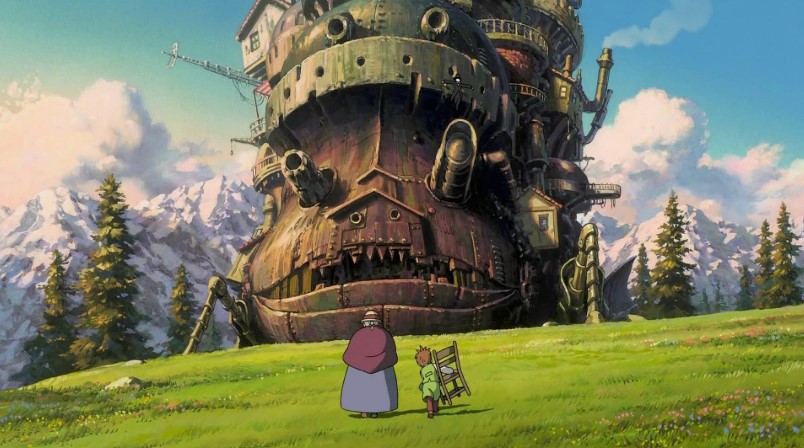
This is the story of Sophie, a young hat seller who is turned into a 90 year old woman by a nasty witch and then sets off into the countryside on a quest to break the spell and return to her usual self. During the course of her adventure she meets many colourful characters including the handsome titular magician Howl, his fire demon friend Calcifer and their moving castle. This movie has clear anti-war themes and Miyazaki has stated that it is in part a reaction to the Iraqi war which he was enraged by. I love that the main character of the film is an old woman as it continues the feminist themes of Miyazaki’s previous work but with a compassionate view towards old people rather than the young. It is certainly refreshing. And of course the old flight motif’s, airships and the like make the usual appearance.
Its almost getting old at this point to say that of course, the animation in this film is phenomenal. It is dense, colourful and detailed and at times almost feels like Miyazaki and co showing off. The fictional locations in this film are wonderful; a particular favourite of mine being Sophie’s hometown of Market Chipping, which is a higgledy-piggledy, cobble-stoned medieval town, inspired by the real-life French town of Colmar which I have actually visited. There is a building there which directly inspired her hat shop, which I got a photo in front of.
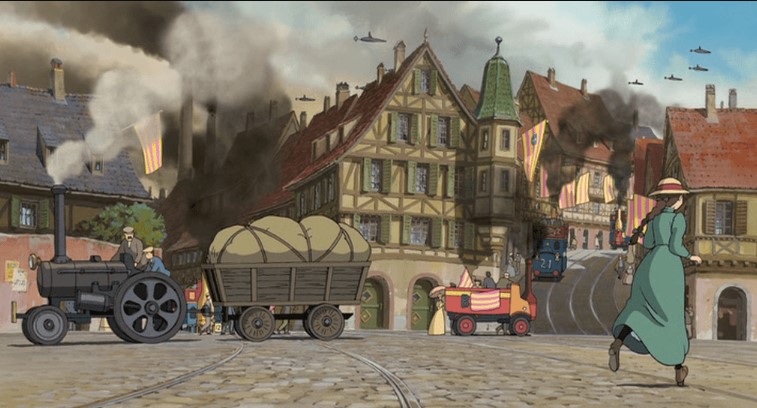
The score to this film is provided by Joe Hisaishi, once again at the top of his game and matches the tone of the film perfectly. Great voice performances are provided by Jean Simmons, Christian Bale, Emily Mortimer, Billy Crystal and more. I think Hollywood actors must’ve been falling over themselves trying to star in a Miyazaki film at this point.
I was lucky enough to see this in the cinema when it first came out and it has been a favourite ever since. It is one of the studio’s best, filled with magic both literally and spiritually and is a wonderful film in every aspect.
TALES FROM EARTHSEA (2006)
“Life is a wave on the sea. Would you force the sea to grow still to save one wave?”
This is an interesting one for various reasons. This was the first film made by Hayao Miyazaki’s son Goro and is notorious for being Ghibli’s first mis-step, the first bad Ghibli film even. I saw it once a year or two after it came out and at the time I pretty much felt the same. As such, this is another one I’ve been looking forward to revisiting with fresh eyes.
That said, I’ll get my verdict out the way early – I think this is a decent film, with issues with pacing and tone, but plenty of good things going for it as well. If this was made by any other studio it would be considered a good film but by Ghibli’s enormously high standards it does fall a bit short, especially with the added weight of being made by Miyazaki’s son. At this point I want to give the synopsis of the film but I realise I’m not entirely sure and therein lies the biggest issue – the plot is quite disjointed and a bit meandering. It starts out with the protagonist Arren joining (being taken?) by a powerful wizard called Sparrowhawk on a quest to find what is causing imbalance in the world and ends with them confronting an evil sorcerer Cob, who is causing the imbalance by trying to achieve immortality. This sounds simple but I can’t really recall how it gets from place to place, it just sort of happens.
The tone of this film is very dour and I cannot think of any moments of comic relief which I think is another issue with the film. It does manage to be compelling or at least interesting. The biggest strength of the film is the antagonist Cob, who is genuinely very scary, speaking in a permanent whisper very well delivered by Willem Defoe. He becomes even scarier towards the end and even reminds me of the horror manga Uzumaki as he ends up with gaping holes where his eyes used to be. Although the film is very serious it does manage to have a personality and atmosphere of it’s own.

The animation is generally excellent as expected with the notable exception of the dragons, which although not terrible, do look rather odd and don’t reach the usual standard, especially when compared to Haku from Spirited Away for example. Further to this I’m not actually sure why the dragons need to be in the film at all. They are used to illustrate the imbalance in the world but this could have been done in other ways and featuring them on promotional art for the film is rather odd when they are barely relevant.

My opinion on the film in the end is that it is better than people say and better than I thought, but is certainly flawed, does feel overlong and a bit meandering and has a very serious, borderline miserable tone. However it is still in an interesting and enjoyable film and certainly worth watching in my opinion.
End of Part 3

